Salary ⇄ Hourly Calculator
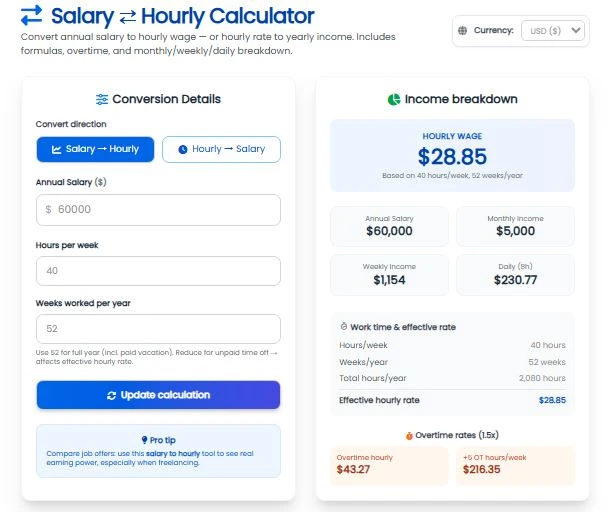
Convert annual salary to hourly wage — or hourly rate to yearly income. Includes formulas, overtime, and monthly/weekly/daily breakdown.
Conversion Details
Use 52 for full year (incl. paid vacation). Reduce for unpaid time off → affects effective hourly rate.
Pro tip
Compare job offers: use this salary to hourly tool to see real earning power, especially when freelancing.
Income breakdown
Hourly Wage
$28.85
Based on 40 hours/week, 52 weeks/year
Annual Salary
$60,000
Monthly Income
$5,000
Weekly Income
$1,154
Daily (8h)
$230.80
⏱ Work time & effective rate
Overtime rates (1.5x)
Overtime hourly
$43.27
+5 OT hours/week
$216.35
Salary & Hourly Conversion Formulas
Salary → Hourly
Hourly = Annual Salary / (Hours/Week × Weeks/Year)
Example: $60,000 / (40 × 52) = $28.85/hour
Hourly → Salary
Annual Salary = Hourly Wage × Hours/Week × Weeks/Year
$28.85 × 40 × 52 = $60,000/year
Monthly / Weekly / Daily
- Monthly = Annual ÷ 12
- Weekly = Annual ÷ Weeks/Year
- Daily (8h) = Hourly × 8
Overtime (1.5×)
- OT Rate = Hourly × 1.5
- Weekly (5 OT hrs) = OT Rate × 5
✨ Formulas assume consistent work schedule. Adjust hours/weeks for part-time, seasonal, or unpaid leave.

Salary to Hourly Conversion: How to Calculate Hourly Wage from Annual Salary (Complete Guide)
Whether you’re comparing a job offer, negotiating a raise, or planning your finances, understanding how to calculate hourly wage from annual salary is essential. This guide covers everything from the basic salary to hourly formula to advanced considerations like benefits, overtime, and freelance adjustments. We also provide a built-in salary calculator approach so you can quickly convert any annual figure into an accurate hourly wage calculator estimate. By mastering salary conversion, you’ll gain clarity on your true earnings and make informed career decisions.
1. Core Formula: Annual Salary to Hourly Rate
The fundamental method to calculate hourly wage from annual salary uses this equation: Hourly Rate = Annual Salary ÷ (Hours per Week × Weeks Worked per Year). For a standard full-time schedule (40 hours/week, 52 weeks/year), the divisor is 2,080. For example, a $70,000 annual salary divided by 2,080 gives $33.65 per hour. This simple salary to hourly rate conversion works for any job, but remember that the “weeks worked” variable can change if you have unpaid time off. This is the foundation of any reliable income calculator.
Quick income reference: A $50,000 annual salary equals roughly $24.04/hour. Use that mental benchmark to gauge offers instantly.
2. Why Adjust Weeks & Hours? Real-World Salary Conversion Nuances
Many people assume 52 working weeks, but if you have unpaid leave, your effective hourly rate increases. For a $60,000 salary to hourly calculation using 50 weeks (instead of 52), the rate jumps from $28.85 to $30.00. Freelancers and contractors often use 46–48 weeks to account for non-billable time. Additionally, part-time workers need to adjust hours per week. A salary calculator that lets you modify these variables gives the most accurate picture. Always align your salary conversion with actual working patterns.
3. Hourly to Salary: The Reverse Calculation
Converting hourly to salary is equally important. Multiply your hourly wage by hours per week and weeks per year. If you earn $35/hour and work 40 hours/week for 52 weeks, your annual salary is $72,800. This hourly wage calculator method helps freelancers project yearly income or compare part-time roles against full-time offers. Understanding both directions makes you a savvy negotiator.
4. Salary Calculator: Factoring Benefits & Hidden Compensation
A true income calculator should account for benefits. Health insurance, 401(k) matching, bonuses, and paid time off add value beyond the base salary to hourly rate figure. For instance, a $65,000 annual salary with $5,000 in employer 401(k) contributions and $3,000 in bonuses effectively raises your total compensation. When comparing jobs, convert total package into an equivalent hourly wage for a fair apples-to-apples comparison. Use a salary calculator that includes these extras.
5. Overtime & Exempt vs Non-Exempt: Impact on Hourly Pay
Hourly employees often receive overtime at 1.5× their base rate, significantly affecting annual earnings. Salaried exempt employees may not get overtime, so their effective hourly wage from annual salary could be lower if they work beyond 40 hours. Always factor in expected overtime when using a hourly wage calculator for role comparison. The Fair Labor Standards Act (FLSA) classification matters.
6. Practical Applications: Job Offers, Freelance Rates & Budgeting
- Job offer comparison: Use salary to hourly conversion to compare a salaried role with an hourly contract.
- Freelance pricing: Determine your target hourly pay by reversing the formula: desired annual salary ÷ (billable weeks × hours).
- Budgeting: Knowing your hourly wage from annual salary helps you value your time for spending decisions.
- Negotiation: Present your salary conversion data to justify raises or counteroffers.
7. Advanced Salary Conversion Tips for Freelancers & Remote Workers
Freelancers should use 46–48 weeks to account for non-billable admin, marketing, and holidays. For example, to achieve a $90,000 annual salary equivalent, divide by 1,920 hours (40 hrs × 48 weeks) to get a $46.88 hourly rate. This ensures your hourly wage calculator reflects true business costs. Remote workers may also need to consider state taxes and currency conversion if working internationally.
Quick reference table: Standard 40‑hour week, 52 weeks/year – divide annual salary by 2,080 to get hourly rate.
Common Salary to Hourly Conversions (40 hrs/week)
| Annual Salary | Hourly Wage | Monthly Income | Weekly Income |
|---|---|---|---|
| $35,000 | $16.83 | $2,917 | $673 |
| $55,000 | $26.44 | $4,583 | $1,058 |
| $75,000 | $36.06 | $6,250 | $1,442 |
| $100,000 | $48.08 | $8,333 | $1,923 |
| $125,000 | $60.10 | $10,417 | $2,404 |
| $150,000 | $72.12 | $12,500 | $2,885 |
*Based on 40 hours/week, 52 weeks/year. Use this as a salary calculator reference.
Frequently Asked Questions: Salary Conversion & Hourly Wage
How do I calculate hourly wage from annual salary accurately?
What is the best salary calculator for comparing job offers?
Can I convert hourly to salary for part-time work?
What is a good hourly rate for a $75,000 salary?
Should I include bonuses in salary conversion?
How does overtime affect my effective hourly wage?
What’s the difference between exempt and non-exempt for salary conversion?
Disclaimer & Informational Purpose
The information provided in this guide is for general informational and educational purposes only. While we strive to keep the content accurate and up-to-date, it does not constitute financial, legal, or professional advice. Salary conversions, tax implications, and employment classifications vary by jurisdiction and individual circumstances. You should consult with a qualified professional for advice tailored to your situation. We make no representations or warranties regarding the accuracy, completeness, or suitability of the information presented. Use of this content is at your own risk.
© 2025 Salary & Career Hub. All trademarks and brand names are property of their respective owners.